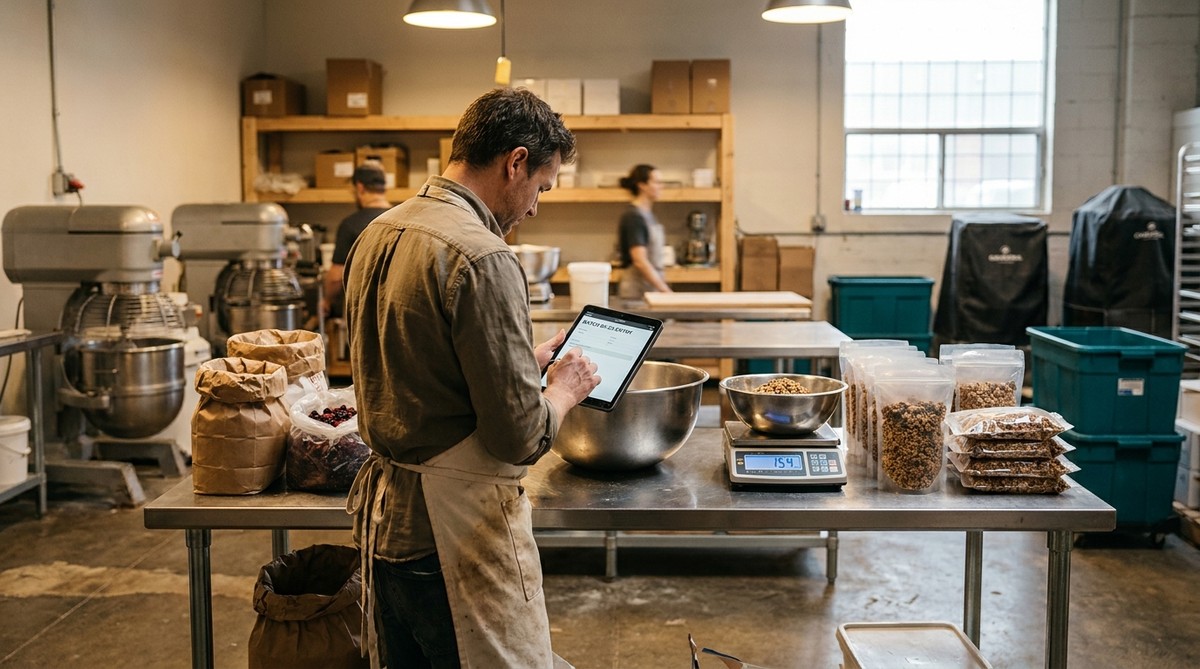
Batch production tracking is the practice of recording exactly which ingredients, in what quantities, went into each production run — and connecting that record to the finished product, the date it was made, and the inventory it depleted. In plain terms: when you make a batch, batch tracking is what tells you what went in, what came out, and what you have left.
For a food manufacturer, this isn’t a nice-to-have. It’s the difference between knowing you have enough sugar for next week’s run and finding out you don’t three days before a delivery is due.
Why batch tracking matters more than it sounds like it should
Most food manufacturers start out tracking production the way anyone would — a notebook, a spreadsheet, or just memory. That works when you’re making one product a week. It stops working the moment you’re running multiple batches, using shared ingredients across different products, and shipping to more than one buyer.
Without batch tracking, three questions become surprisingly hard to answer: How much of an ingredient do you actually have left, once you account for what’s committed to batches already scheduled? Which batch did a specific bag of finished product come from, if a buyer asks? And can you commit to a new order without knowing, for certain, whether you have what it takes to fill it?
Heritage Confections found this out the expensive way. Three days before a large delivery, a routine check turned up a problem that should have been caught weeks earlier — they were out of sugar, and the real supplier needed a week and a half to restock. There was no time to wait, so the only option was a same-day run to buy cane sugar at full retail price, which erased nearly all the profit on that order. The ingredient was on hand until, suddenly, the math said otherwise, and nobody had connected “sugar used in batches” to “sugar remaining” until it was too late to fix cheaply.
What batch tracking actually records
A proper batch tracking system captures four things for every production run:
The ingredients consumed. Not just “we used sugar” — the specific quantity, pulled from a specific inventory lot, at the moment the batch was recorded.
The finished product created. What came out of the batch, in what quantity, ready to become sellable inventory.
The date and batch identifier. So that if a question ever comes up about a specific unit of product — a quality issue, a recall, a buyer inquiry — you can trace it back to exactly which run it came from.
The inventory adjustment. The ingredients used get subtracted from what’s on hand automatically, and the finished product gets added, in the same motion. This is the connection a spreadsheet can’t make without someone doing it by hand, batch after batch.
Batch tracking vs. just tracking inventory
These get confused, but they’re not the same thing. Inventory tracking tells you what you have on hand, at a point in time. Batch tracking tells you how it got used — which batch consumed which ingredients, and what that batch became.
You need both, and they need to talk to each other. Inventory tracking without batch tracking means you know you have 40 lbs of sugar today, but not how fast it’s actually depleting across your production schedule, or when you’ll run out relative to your next order. Batch tracking without inventory tracking means you have a record of what happened in the past, with no forward view of what you can commit to next.
How to know if you need it
A few signals tend to show up before a manufacturer realizes batch tracking has become necessary rather than optional:
- You’re running more than one batch per week, or more than one product line.
- You’ve had to guess whether you had enough of an ingredient for a scheduled run.
- A buyer or retailer has asked for traceability on a specific product, and pulling the answer together took longer than it should have.
- You’re buying ingredients in bulk, which means tracking the same lot across multiple batches over several weeks.
- You’ve had an ingredient run out mid-schedule, with no warning before it became urgent.
Any one of these on its own is manageable. Two or three together usually mean the manual system has stopped working.
What to look for in batch tracking software
The right tool connects batch tracking directly to ingredient inventory and recipe costing, so recording a production run does three things automatically: depletes the ingredients used, adds the finished product to available inventory, and updates the batch’s actual cost based on current ingredient prices — not what they cost when the recipe was first built.
For food manufacturers specifically, look for support for both made-to-order and scheduled batch production, since most small manufacturers run some mix of the two. See Food Manufacturing Inventory Management: Why Spreadsheets Stop Working at $50k Revenue for the broader signals that a spreadsheet-based system has stopped scaling.
Frequently Asked Questions
What is batch production tracking? Batch production tracking is the process of recording which ingredients, in what quantities, went into a specific production run, and connecting that record to the finished product it created and the inventory it used up. It’s what allows a food manufacturer to know exactly what a batch consumed and what came out of it.
Why do food manufacturers need batch tracking? Without it, ingredient usage across batches has to be reconciled manually, which breaks down once a manufacturer is running multiple batches or product lines. Batch tracking also enables traceability — being able to answer which batch a specific unit of product came from, which retail buyers increasingly expect.
Is batch tracking the same as inventory management? No. Inventory management tells you what you have on hand. Batch tracking tells you how that inventory gets used — which batch consumed which ingredients and what it became. Food manufacturers need both, connected to each other.
Can I do batch tracking in a spreadsheet? Yes, at small scale. It becomes error-prone once you’re running multiple batches weekly, sharing ingredients across product lines, or buying in bulk lots that span several production runs. At that point, reconciling manually creates the exact gap that leads to running out of an ingredient without warning.
Does made-to-order production need batch tracking too? Yes. Made-to-order still consumes ingredients per production run, and still needs traceability if a buyer or retailer asks about a specific unit. The difference is timing — the check happens at order confirmation rather than against a standing schedule — but the tracking need doesn’t go away.
Batch production tracking is one of the systems Caska was built around. Try it free for 7 days at go.caska.app.
See also: How to Calculate Your Food Product’s True Profit Margin