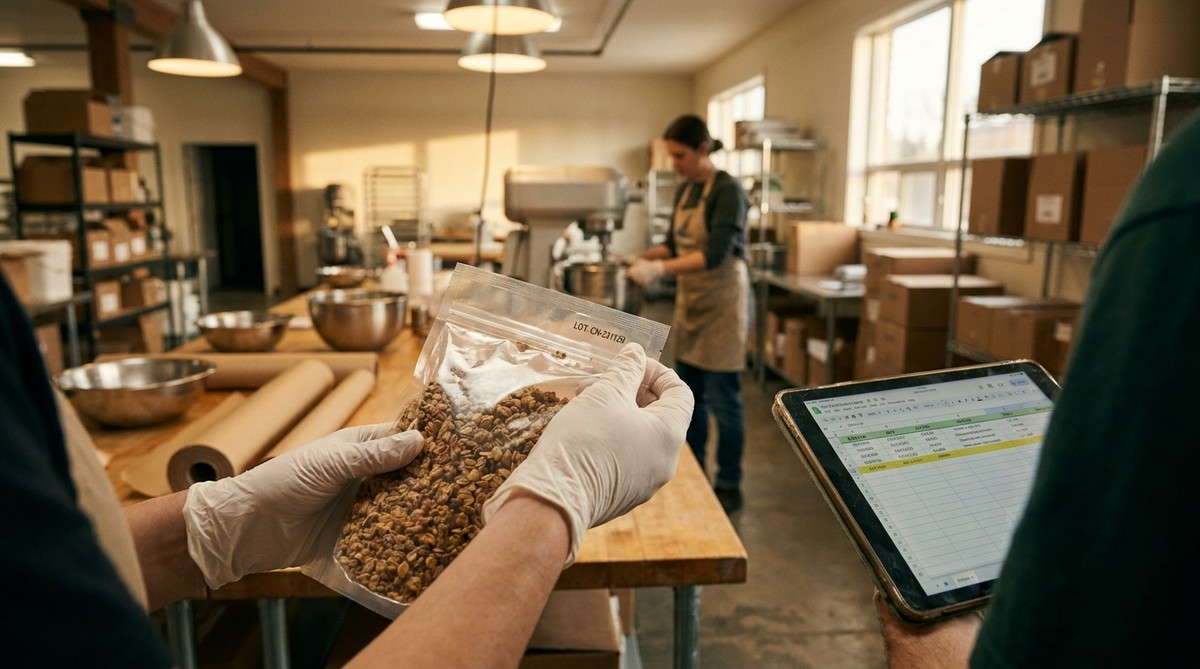
Food traceability is the ability to trace any unit of finished product backward to the ingredients and production run that made it, and forward to know exactly where that run ended up once it left your facility. For a food manufacturer, that comes down to two questions you need to answer on demand: what’s actually in this specific unit, and where else did the rest of that batch go. Lot tracking is the mechanism that makes both answerable: a system of identifiers that ties an incoming ingredient shipment, the production run it was used in, and the finished units that came out of it, all together, so nobody has to reconstruct it from memory or a stack of old invoices.
Recall readiness is the reason traceability stops being optional once you’re selling into retail. If a supplier issues an allergen recall on an ingredient lot, or a quality issue turns up in one specific run, the question a retailer or regulator asks is concrete: which units contain the affected ingredient, and where are they right now. A manufacturer with lot tracking in place answers that in minutes. One without it either guesses, pulls every unit off every shelf to be safe, or hopes the problem doesn’t surface before it’s caught some other way. Retail buyers know the difference, which is why traceability increasingly comes up during onboarding conversations, not just after something’s gone wrong.
How lot tracking works
A lot number gets assigned the moment an ingredient shipment arrives: one identifier per delivery, even if it’s the same ingredient you’ve bought a dozen times before. When that ingredient goes into a production run, the system records which lot was used, in what quantity, alongside every other ingredient in that batch. The finished units coming out of the run get their own batch or lot code, usually printed right on the packaging, and that code is what ties everything together after the fact. Pull up a finished unit’s code, and you should be able to see every ingredient lot that went into it. Pull up an ingredient lot, and you should be able to see every finished batch it touched.
What a recall requires
When a recall notice comes in, whether it’s from a supplier, a retailer, or a regulator, the clock starts immediately. You need to identify which of your own production runs used the affected ingredient lot, cross-reference that against every finished batch those runs produced, and know which accounts received those specific units. If you sell into retail in Canada, the Safe Food for Canadians Regulations require you to produce this information within a set window when asked, covering one step back to your supplier and one step forward to who you sold to. A manual system can technically get there, given enough time digging through paperwork. Lot tracking gets there before the phone call ends.
Traceability vs. batch tracking
These two get used almost interchangeably, but they answer slightly different questions. Batch production tracking records what went into a production run and what came out of it, the mechanics of the batch itself. Traceability is what you get once that batch data is connected end to end: ingredient lot in, finished units out, and a clear line between the two that holds up when someone asks. You can’t have real traceability without batch tracking underneath it. Batch tracking without the traceability layer on top just gets you a record with no way to search it quickly when it matters.
Signals you need this now
A few patterns tend to show up before a manufacturer realizes traceability has moved from nice-to-have to necessary:
- A grocery buyer has asked for traceability documentation you couldn’t produce quickly.
- You’re buying the same ingredient from more than one supplier, or in lots that span multiple production runs.
- You’ve had a supplier issue a recall or quality notice and had to guess how far it reached into your own inventory.
- You’re shipping to more than a handful of retail accounts and couldn’t say, today, which ones received a specific batch.
- Your traceability process currently lives in someone’s memory of “that was probably the batch from last Tuesday.”
Any one of these is manageable with enough manual effort. Two or three together usually mean the manual system is one bad week away from failing you.
Frequently Asked Questions
What is food traceability? Food traceability is the ability to track a product from the ingredients that made it through to the finished units sold, and to identify who received those units. It answers “what’s in this” and “where did the rest of it go” on demand, rather than after hours of digging.
What is lot tracking? Lot tracking is the practical system behind traceability: assigning identifiers to incoming ingredient shipments and outgoing finished batches, and recording the connection between them, so a specific unit can be traced back to exactly what it contains and forward to where it was shipped.
Do small food manufacturers need traceability, or is that just for large companies? Any manufacturer selling into retail needs it. Regulatory requirements don’t scale down for small operations, and retail buyers ask for it regardless of company size. The difference at small scale is that traceability can often be maintained without dedicated software, until order volume or supplier complexity makes that unreliable.
Is traceability the same as batch tracking? No, but they’re connected. Batch tracking records what happened during a production run. Traceability is the end-to-end line from ingredient lot to finished unit to customer that batch tracking data makes possible when it’s structured to be searchable.
What happens if I can’t produce traceability information during a recall? At minimum, it slows down your response and forces a broader recall than necessary, since you can’t isolate which units are actually affected. It also damages trust with retail accounts who expect this information on request, recall or not.
Can I build traceability with a spreadsheet? At very small volume, yes, if you’re disciplined about recording lot numbers on both the ingredient and production side. It becomes fragile once you’re running multiple batches a week, buying from more than one supplier for the same ingredient, or shipping to enough accounts that manually reconstructing “who got what” takes longer than a recall response allows.
See also: What Is Batch Production Tracking? A Plain-English Guide for Food Manufacturers