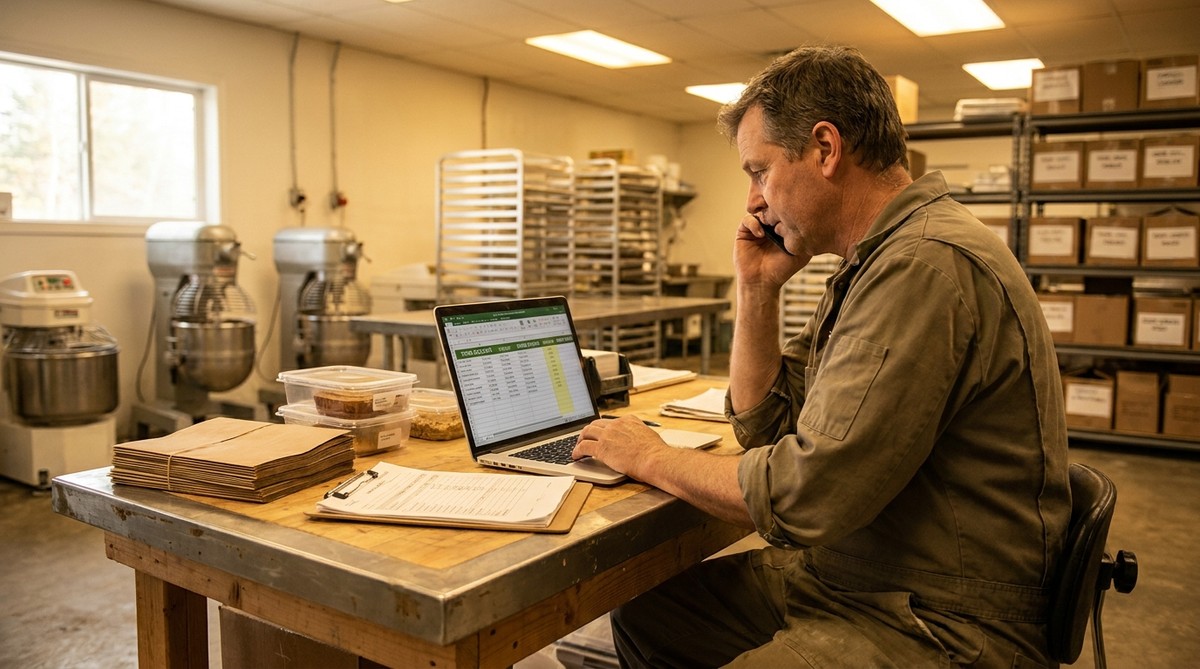
Managing grocery buyer relationships as a small food brand means four things: knowing exactly who your contact is at each store, timing your outreach to how your product actually sells, keeping a working record of order history, and having a system to re-engage accounts before they go cold. Most small food brands try to do this from memory or a patchwork of notes — and most small food brands lose accounts not because the relationship broke, but because nobody was maintaining it.
Here’s how to fix that.
The relationship doesn’t end when you get on the shelf
When we took possession of Heritage Confections, the previous owner handed us the keys to a business he’d run for twenty years out of a handwritten date book — every customer, every phone number, every order note, all in one book. The date book went missing in the handover. First month: no customer list, no order history, no idea who’d ordered what, who to call, or when anything was due. We had live accounts with no record of them existing.
Getting listed in a store feels like the finish line. But that couldn’t be further from the truth. It’s the start of a relationship that needs to be actively managed — because grocery buyers are busy, their shelves are crowded, and a product that isn’t regularly, genuinely visible to the buyer will quietly get swapped out for something that is. The brands that keep their shelf space long-term treat their buyer list like the asset it is: documented, organized, and worked on a real system.
Know exactly who you’re talking to
Every retail account needs a contact record — not just a store name, but the buyer’s actual name, their direct line or email, who covers when they’re on holiday, and any notes about how they like to be reached. Some buyers are email-only. Others find email impersonal and want a call. Getting this wrong means your outreach lands in a void.
You also want to know their reset cycle — the window when they review their shelf and decide what stays, what gets cut, and what gets added. Walk in with a reorder conversation the week after a reset and you’ve missed the decision window by a month and a half. Walk in the week before, when they’re actively thinking about what’s on their shelf, and it’s a completely different conversation.
None of this is hard to track — it’s a few fields per account — but it needs to be written down somewhere reliable, not carried in your head (and definitely not in a date book that could go missing on any given Tuesday!)
Time your outreach to the shelf, not the calendar
The most common mistake when building a follow-up system is treating it like a marketing drip: reach out, wait seven days, reach out again. That cadence makes sense when you’re nurturing a lead who hasn’t bought anything yet. It doesn’t make sense for a grocery buyer who’s already stocking your product and operates on shelf cycles, not email marketing cycles.
The right question isn’t “how many days since my last message?” — it’s “is this store probably running low yet?” That depends on your product’s sell-through rate: how many units a typical store carries and how fast they move. We’ve covered the mechanics of building a sell-through-based cadence in depth in this post on grocery buyer CRM — but the short version is that your follow-up timing should be driven by shelf behaviour, and your follow-up message should feel like a useful heads-up, not a sales nudge.
Track order history like it matters — because it does
Every reorder conversation goes better when you know what an account has ordered before and when. Not to recite it back to them, but because the patterns tell you things you can’t get any other way: the account that used to order every three weeks and is now stretching to five, the seasonal buyer who reliably comes alive in November, the store that doubled their order after a local event and might be ready to do it again.
Order history also protects you. When a buyer says “we ordered this at $X last time” or “we only got twelve units,” you want to be able to confirm or correct that without digging through your inbox for forty-five minutes.
Keep it simple: account name, order dates, quantities, and a notes field for anything worth remembering from the conversation. That’s the whole thing. You don’t need a complex setup to start — you just need the data somewhere that isn’t your memory.
Re-engaging a lapsed account without it being awkward
Every brand has accounts that go quiet. A buyer changes, a season ends, a slow stretch passes and somehow neither of you has called in three months. It happens, and it’s usually recoverable, but the longer it sits the more like an apology the re-engagement feels.
The key is to have a reason to call that isn’t “we haven’t talked in a while.” A new product is the obvious one, but it doesn’t have to be that significant — a seasonal SKU, a new store you just got listed in nearby, a packaging update. You’re giving them something to respond to, not just showing up to fill an awkward silence.
Before we had a proper follow-up system at Heritage, we had over 150 stores in our database and slow months that felt inexplicable — accounts that were warm one season and silent the next, with no clear view of who was drifting. After we automated the re-engagement side, those accounts stayed warm through the slow stretches, and it directly contributed to doubling our revenue in year two. The follow-up wasn’t interrupting them. For most of those buyers, it was a useful reminder that we existed and were paying attention.
What the whole system looks like
Put it all together and you need four things:
- A contact record for every account — name, role, preferred contact method, reset cycle
- A follow-up cadence based on sell-through, not a calendar — two or three templates by account volume
- Order history that’s actually current — dates, quantities, notes from conversations
- A way to see who needs attention — upcoming reorders, accounts going quiet, seasonal windows coming up
That’s the whole system. The brands that hold their shelf space aren’t doing anything mysterious — they’re just doing this consistently, and they have somewhere to put the information so it doesn’t live in their heads.
If you’re running this out of a spreadsheet right now, it works up to a point — and then a buyer changes, or a season slips by, or an account goes quiet and you only notice three months later. Caska was built to handle this workflow: buyer contacts, follow-up scheduling, order history, and automated re-engagement, without needing to configure it for six weeks before it does anything useful. Plans start at $39/month CAD, and there’s a 7-day free trial if you want to see how it fits your account list.
Frequently Asked Questions
What information should I track for each grocery buyer? At minimum: the buyer’s name and direct contact, their store’s order history (dates and quantities), their reset or review cycle, and any notes about communication preferences. These four things make every conversation more useful and protect you when buyers change roles.
How often should a small food brand follow up with a grocery buyer? Base your timing on your product’s sell-through rate — how long it takes a typical store to work through what they’ve bought — not a fixed calendar interval. A seven-day drip cadence is designed for sales funnels, not shelf replenishment. For a deeper breakdown, see Grocery Buyer CRM for Food Manufacturers.
What do I do when a grocery buyer goes quiet? Don’t wait too long, and lead with something useful rather than a check-in. A new product, a seasonal angle, or a nearby listing gives them a concrete reason to respond. The longer the gap, the more important it is to have a genuine hook for the conversation.
What CRM do small food brands use for retail buyer management? Most start with spreadsheets, which work at low volume but degrade as the account list grows. Purpose-built tools like Caska include retail buyer CRM with follow-up scheduling and order history designed for food manufacturers — no complex setup required. Plans start at $39/month CAD.
Do I need different follow-up approaches for grocery chains vs. independent stores? Yes. Chain buyers typically have formal review windows and structured communication preferences. Independent store buyers are often more accessible but more reactive — they respond better to timely, personal outreach. Building separate cadence templates for each type makes a noticeable difference.