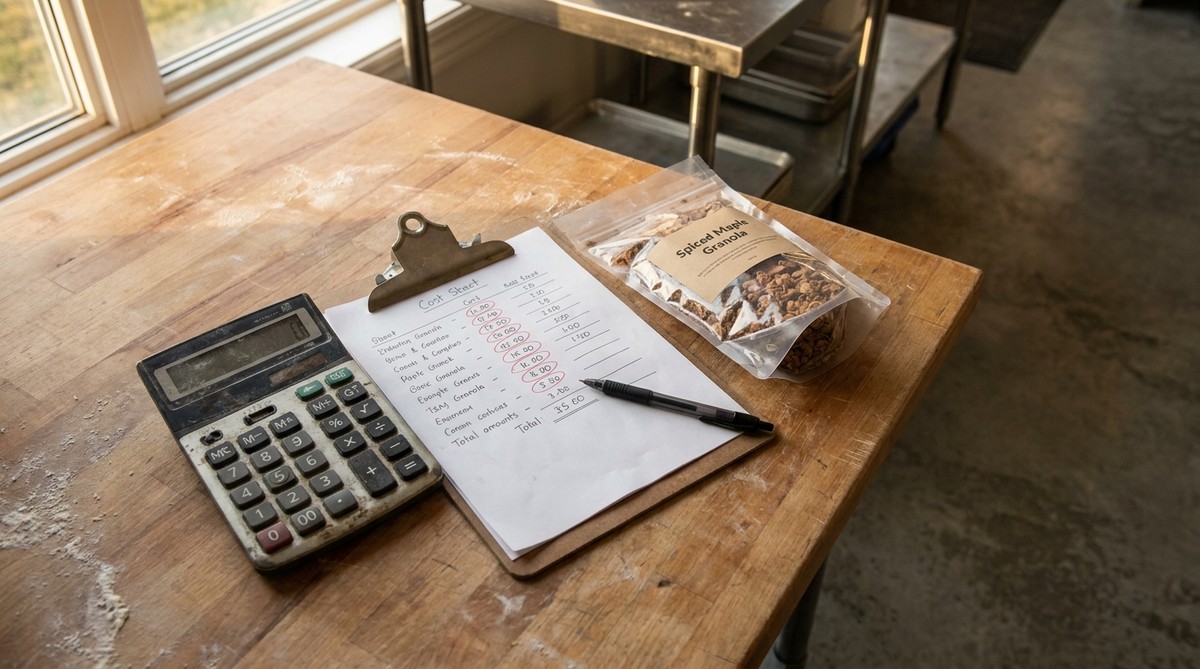
So you did the math. You sat down, added up ingredients and packaging and labour and delivery, and you finally have a real number instead of a guess — and now you’re staring at it wondering what you’re actually supposed to do with it. Knowing your margin is the first step, not the whole job. The second step is going back through the business and finding the specific places it’s leaking, because it’s almost never one big problem. It’s four or five small ones, stacked.
Here’s where small food manufacturers actually find the room to improve, once they know what they’re looking at.
Reprice On a Schedule, Not When You Remember
Ingredient costs move constantly and your wholesale price doesn’t move with them unless you make it. Most food businesses set a price once, feel good about it, and then let it sit for a year or two while flour, sugar, packaging, and everything else quietly climbs underneath it. By the time someone notices, the margin has drifted.
Put a repricing check on the calendar (quarterly is reasonable for most small manufacturers) and actually run the true cost calculation again each time, not a gut check. If you haven’t run that calculation properly yet, here’s the full step-by-step with real numbers, because you can’t reprice against a number you’re guessing at.
Look at Margin by Channel, Not Just by the Business
This is the one that changes the math the most, and it’s the one most food manufacturers skip because it means looking at something uncomfortable.
We treated every order at Heritage Confections like a win for a long time. A store wanted product, we shipped it, revenue went up, and that felt like the business working. Then I actually sat down and separated shipped orders from locally delivered ones and did the real math on each. Not revenue, but actual margin after packaging, shipping, and breakage. Local delivery was running us 45 to 52%. Shipped orders were sitting under 4%. Months of what looked like growth were, once you counted everything, barely breaking even, and in some cases losing money outright.
That’s not a story about shipping specifically - it’s a story about the fact that revenue and profit are not the same number, and a business can be growing on paper while individual channels quietly bleed it dry. We stopped shipping those accounts immediately once we saw it. If you’ve never broken your own numbers down by channel, retailer, or fulfillment method, that’s usually where the biggest single fix is hiding, because it’s the number nobody’s looking at until they’re forced to.
Renegotiate or Cut the Accounts That Aren’t Working
Once you can see margin by account, some of them are going to be obviously not worth what they’re costing you. The instinct to keep every account because “an order is an order” is exactly what let the problem grow in the first place. A few options once you know which accounts are dragging: renegotiate pricing or minimum order sizes with the retailer directly, shift fulfillment to something cheaper (local delivery instead of shipping, batching orders instead of one-offs), or in some cases just walk away from the account entirely. Losing a low-margin account on purpose is not the same as losing revenue. It’s usually the opposite of that.
Cut Waste Before You Cut Anything Else
Yield loss is one of the easiest places to find margin because it’s rarely tracked at all. Every batch loses something. Trim, quality rejects, overfill, and product that doesn’t survive packaging. And if you’re calculating cost off the theoretical batch size instead of what you actually end up with, your real cost per unit is higher than your spreadsheet says it is. Track actual yield against theoretical yield for a few production runs and you’ll usually find a gap worth looking into further. Small percentage points here add up fast at volume, and unlike renegotiating with a retailer, this one is entirely inside your control.
Know the Number Before You Try to Move It
None of this works without accurate, current cost data, and that’s where most of this quietly falls apart for small manufacturers. Not because the math is hard, but because keeping it current is a full-time job nobody signed up for. A spreadsheet formula references last year’s ingredient price. A recipe gets adjusted and the cost sheet doesn’t. The margin number everyone’s making decisions off of is technically wrong and nobody notices until a “good month” doesn’t feel like one.
This is the specific gap Caska’s recipe costing closes. Ingredient costs pull from your actual inventory, margin recalculates automatically when a supplier changes their price, and you can see true per-unit and per-channel profitability without maintaining formulas by hand. It’s the tool version of the exercise we ran manually at Heritage, and it’s a large part of how our margins moved from 42% to 55% once we stopped guessing and started tracking it properly.
If you want to see your own numbers this clearly, the 7-day free trial at go.caska.app is the fastest way to find out — or take a look at what Caska actually does first if you want the full picture before you commit to anything.
Margin doesn’t usually disappear in one dramatic moment. It leaks out through stale pricing, accounts that cost more than they earn, and waste nobody’s counting. And every one of those is fixable once you can actually see it.