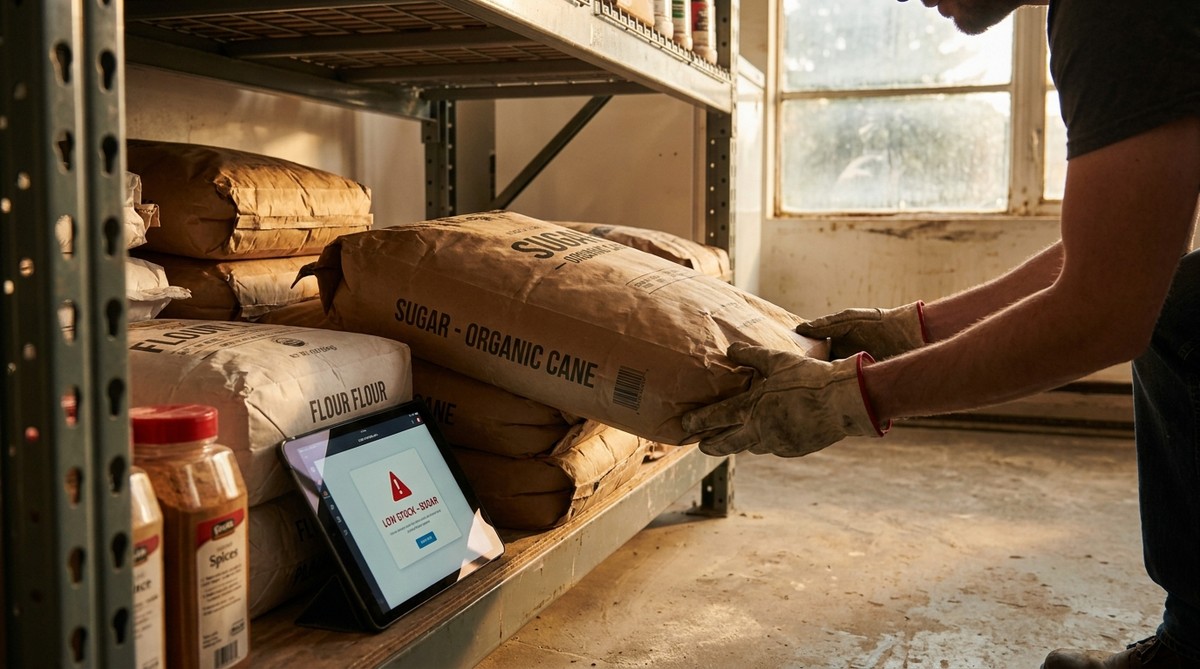
Running out of a core ingredient mid-production isn’t a scheduling problem, it’s an inventory system problem. The fix isn’t checking your stock more often, it’s building in the triggers that tell you when to reorder before you’re already short, because by the time you notice you’re low, you’re usually out of runway to fix it the cheap way.
We learned this one the hard way. Three days before a big delivery, we did an ingredient check for the next production run and realized we were completely out of sugar. Our supplier needed a week and a half to get more to us, and there was no version of that timeline that worked when a customer was expecting product in three days. So I got in the car, drove to Walmart, and bought bags of cane sugar at full retail price to fill the gap. It worked, in the sense that the order shipped. It also wiped out almost all the profit on that run, because retail sugar prices are nowhere close to what we’d normally pay wholesale.
Why running out sneaks up on you
The uncomfortable part of that story is that nothing in our system told us it was coming. We had a number on a spreadsheet that represented “how much sugar we have,” and that number was accurate right up until it wasn’t, because nothing in the sheet accounted for how fast we were using it or how long it would take to get more. A static count only tells you where you stand today. It says nothing about whether today’s number is a problem three days from now, which is exactly the window where you need the warning.
Most food manufacturers running spreadsheets have some version of this gap, not because they’re not paying attention, but because a spreadsheet number doesn’t do the math for you. Knowing you have 40 lbs of sugar left doesn’t tell you whether that’s two weeks of runway or two days, and it definitely doesn’t tell you when to place the next order so you’re never standing in a store parking lot doing emergency math on a Tuesday.
The three numbers that actually prevent this
Fixing this means tracking three specific numbers per ingredient instead of one.
Reorder point. The stock level that should trigger a new order automatically, calculated from how much you use per week and how long your supplier takes to deliver. If you go through 20 lbs of sugar a week and your supplier takes a week and a half, your reorder point isn’t “when I’m out,” it’s roughly 30 lbs — the amount you’ll use while waiting for the next shipment to arrive.
Safety stock. A buffer on top of the reorder point for the stuff you can’t fully predict — a bigger-than-usual order, a supplier running a few days late, a batch that used more than planned. Without it, your reorder point only works if everything goes exactly as expected, and running a food business, that’s rarely the case.
Lead time. How long it really takes from placing an order to having the ingredient in hand, not how long it’s supposed to take. Suppliers slip. Shipping gets delayed around holidays. If you’re using the quoted lead time instead of the real one, your reorder point is quietly wrong every time you rely on it.
Put those three together and you get a number that tells you exactly when to reorder, not just how much you have left today. That’s the difference between a system that warns you and one that just reports.
What this looks like in practice
Take the sugar example. If we’d had a reorder point set for it, say, reorder at 30 lbs, with a small safety stock buffer for the weeks we ran heavier production, the system would have told us to place that order almost two weeks before we needed it, back when our supplier’s normal lead time still worked fine. Instead, we found out the day the number hit zero, at exactly the moment it was too late to do anything but pay retail.
This is doable in a spreadsheet in theory. In practice, it means manually recalculating usage rates every time production changes, remembering to check it on a schedule, and updating it whenever a supplier’s lead time shifts — and that’s the part that breaks down first, because it’s one more thing competing for your attention against everything else running a food business throws at you.
Caska tracks reorder points, safety stock, and lead time per ingredient automatically, and flags what needs reordering before you’re anywhere close to empty — the exact warning that would have kept us out of a Walmart parking lot with a cart full of retail sugar. For the bigger picture of where spreadsheet tracking breaks down and what replaces it, see Food Manufacturing Inventory Management: Why Spreadsheets Stop Working at $50k Revenue.
If you want to see what that looks like against your own ingredients, try Caska free for 7 days.
See also: Food Manufacturing Inventory Management: Why Spreadsheets Stop Working at $50k Revenue