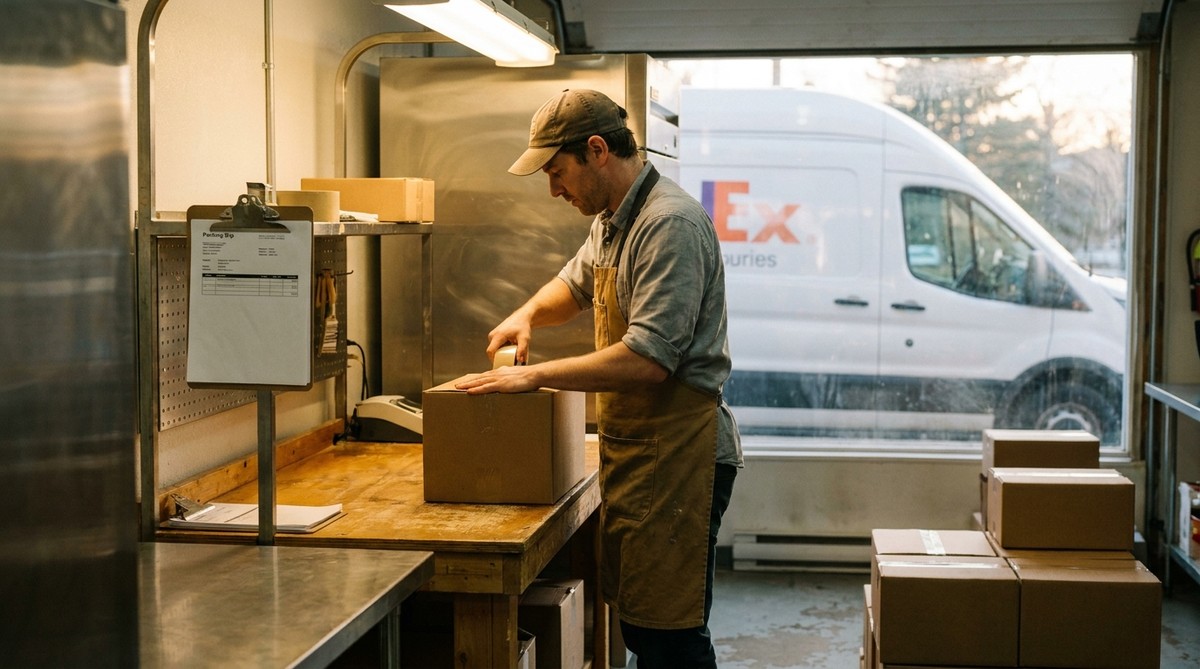
A wholesale order isn’t done when you hit “confirm.” It’s done when the store has the product, the paperwork matches what shipped, and you’ve been paid for it, and there are a lot of steps between those two points where a small food manufacturer can lose track of an order, ship the wrong thing, or eat a cost nobody budgeted for. If you’ve ever had a buyer call asking where their order is and you had to go dig through three different places to find out, this post is about closing that gap.
We didn’t figure this out from a textbook. When I sat down and ran the numbers on Heritage’s shipped orders versus locally delivered ones, the shipped accounts were returning under 4% profit margin against a normal 45 to 52% on local delivery, once packaging, breakage, and shipping costs were factored in. Revenue looked fine. Profit on those specific orders was almost nothing, and nobody had noticed, because nobody was tracking margin at the order level, only at the “did it ship” level. That’s the trap of treating fulfillment as a logistics task instead of a financial one: every step from PO to delivered is also a place where cost gets added, and if you’re not watching it, you find out the hard way, the same way we did.
What happens between “order placed” and “order delivered”
Break it into six steps and it stops feeling like a black box.
-
PO intake. The order arrives, by email, phone, text, or a purchase order document from a bigger retailer, and it needs to become one record: what was ordered, in what quantity, at what price, for delivery by when. If this step happens in your head or in a notebook, everything downstream inherits that risk.
-
Pick and pack. Someone pulls the product against the order, not against memory of what the order probably was. Quantity errors happen here most often, usually when the picker is working from a verbal instruction instead of the actual order record.
-
Packing slip. The slip that goes with the shipment should match the order record exactly, item for item, quantity for quantity. A mismatch here is what turns into a phone call from an annoyed buyer three days later.
-
Delivery or courier. This is the decision that costs you the most money, and it’s the one small manufacturers make the least deliberately. Local delivery, your own vehicle or a local courier, versus shipping farther out to chase a bigger account. It feels like growth either way. It isn’t always profit either way, and that’s exactly what tripped Heritage up before the 4% margin reckoning forced a hard look at which orders were worth taking and which delivery method made sense for each one.
-
Invoicing. The invoice should come straight off the same order record, not get rebuilt from scratch or reconciled against a separate spreadsheet after the fact. Every manual re-entry between “shipped” and “invoiced” is a chance for the numbers to drift apart.
-
Confirmed receipt. The order isn’t closed until the buyer has it and agrees it’s correct. Skip this step and discrepancies sit unnoticed for weeks, until they show up as a dispute or a short payment.
Where it breaks
Almost every fulfillment problem we hear about from small food manufacturers traces back to one thing: the order exists in more than one place, and those places don’t agree. The PO lives in an email, the pick list is written on paper, the packing slip is typed up separately, and the invoice gets built later from whatever anyone remembers. Every one of those hand-offs is a chance to lose a decimal point, ship a case instead of a half case, or forget the order was placed at all.
The other failure, the quieter one, is treating delivery method as a shipping decision instead of a margin decision. It’s easy to say yes to an order because a bigger account feels like validation. It’s harder to sit down and ask whether that order, once you account for how it gets delivered, is making you money or just making you busy.
What fixes it
One order record that stays the same record all the way through, from PO intake to pick list to packing slip to invoice, instead of a fresh copy typed at every step. When the record doesn’t change hands, the numbers on the packing slip match the numbers on the invoice, because they were never re-entered in the first place. That’s what Caska’s order management does: an order gets logged once and everything downstream, production, inventory, shipping, invoicing, reads from that same record. Paired with margin visibility at the order level, so a delivery-method decision is a numbers decision, not a gut call. See Order Management for Food Manufacturers for the intake side of this, and Simple Ways to Increase Your Profit Margins as a Small Food Manufacturer for the margin math itself.
If your fulfillment process currently depends on someone remembering to reconcile the packing slip against the invoice by hand, that’s a systems gap, not a training problem. See what Caska does, or try it free for 7 days and watch a full order run from PO to paid without a single re-typed number.