On March 21, 2022, my sister Colette and I got the keys to Heritage Confections, a popcorn company that had been running for almost twenty years, and it took us about a week to figure out that most of the actual business hadn’t come with them.
The business was in a date book.
It was one handwritten book, and the previous owner had run two decades of customers out of it, every store, every phone number, every standing order, every note about who ordered what and how often and who you absolutely did not call before ten in the morning. (I’m guessing about that last part. I never actually got to read it.) Somewhere in the handover, between the boxes and the keys and the very long stack of things you sign when you buy a company, the date book went missing.
So, who are our customers?
When you buy a twenty-year-old food business without its date book, you end up with a production space, equipment, recipes, a brand people in Alberta actually recognize, and no idea who your customers are.
I had no food experience going in, which matters for how the next part went. I didn’t know what a normal reorder cycle looked like for a grocery store. I didn’t know which stores were active accounts and which ones had stopped ordering years ago. I didn’t know if the store I was about to call had ever heard of us, or had us on the shelf right that minute, or had been waiting two weeks for a delivery that nobody on our end knew they were owed.
The plan, such as it was, was to find every store that might possibly carry Heritage, call it, and ask, and that was pretty much the whole strategy.
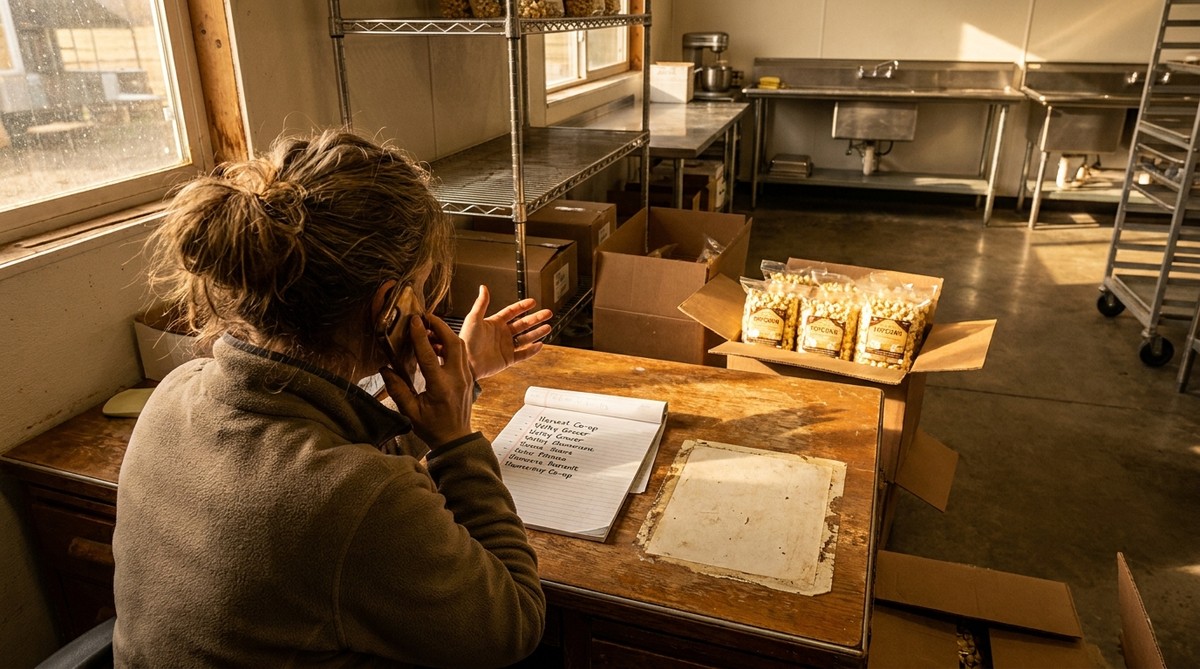
Armed with a chain-generated list of ALL stores, I pieced together a list from whatever turned up (paperwork, labels, past order forms) and a fair amount of guessing. Then I sat down and started dialing, and pretty much every call opened the same way: “Hi, this is Gabby, I’m the new owner of Heritage Confections, and I’m calling because… um. Are you a customer of ours?”
Cold-calling strangers is awkward enough. Cold-calling people who might already be paying you, and asking them to confirm it, is a whole other level. I got yeses, I got a few confused “who?“s, and I got the occasional yes that came with a pointed “and where have you been?” A few stores had only ever dealt with the previous owner and figured the company had closed, which was a fun thing to hear on day nine of owning it.
What was actually in that book
It took me a while to understand what we’d lost. The list part I could rebuild, and mostly did, one phone call at a time. What I couldn’t rebuild was everything written around the list: which buyer wanted a heads-up before a delivery and which one hated being called at all, which store took a big order every November and nothing in January, who had been promised what and whether that was twenty years ago or last Tuesday. That lived in the margins of the book and partly in the previous owner’s head, and the book was gone, and the head had (very reasonably) moved on with its life.
He ran a business for twenty years with a pen and a book and it worked for him, because he was the system. The book didn’t need to make sense to anybody else, since nobody else was ever going to need it, right up until somebody did, and that somebody was me, on the phone, asking a grocery manager whether we were still friends.
The month after that
By the end of the first month we had a working list of stores. Mostly. I’m sure there were accounts we lost for good without ever knowing they existed, a little shop somewhere that ordered twice a year and just never heard from us again, and that’s the bit that still bugs me, because I’ll never know how many there were.
Then I did what any new owner with no food experience and a mild panic going does. I built a spreadsheet, then another one, then a spreadsheet to keep track of the other spreadsheets, which is not a sentence I say with pride. Every store and every order got written down somewhere that wasn’t a book and wasn’t my head. If you’ve ever wondered what’s actually worth tracking per store, I wrote about that in grocery buyer relationship management.
Those spreadsheets eventually grew up into Caska, the software we run Heritage on now, and that other food manufacturers use too. I think about the date book pretty much every time I pull up a store’s order history and it just loads. (Colette thinks about it less. She runs production, so in that first month she got to make popcorn while I made phone calls.)
I still don’t know where that book ended up. Somewhere out there is twenty years of a business written in pen, and I’d honestly love to read it.